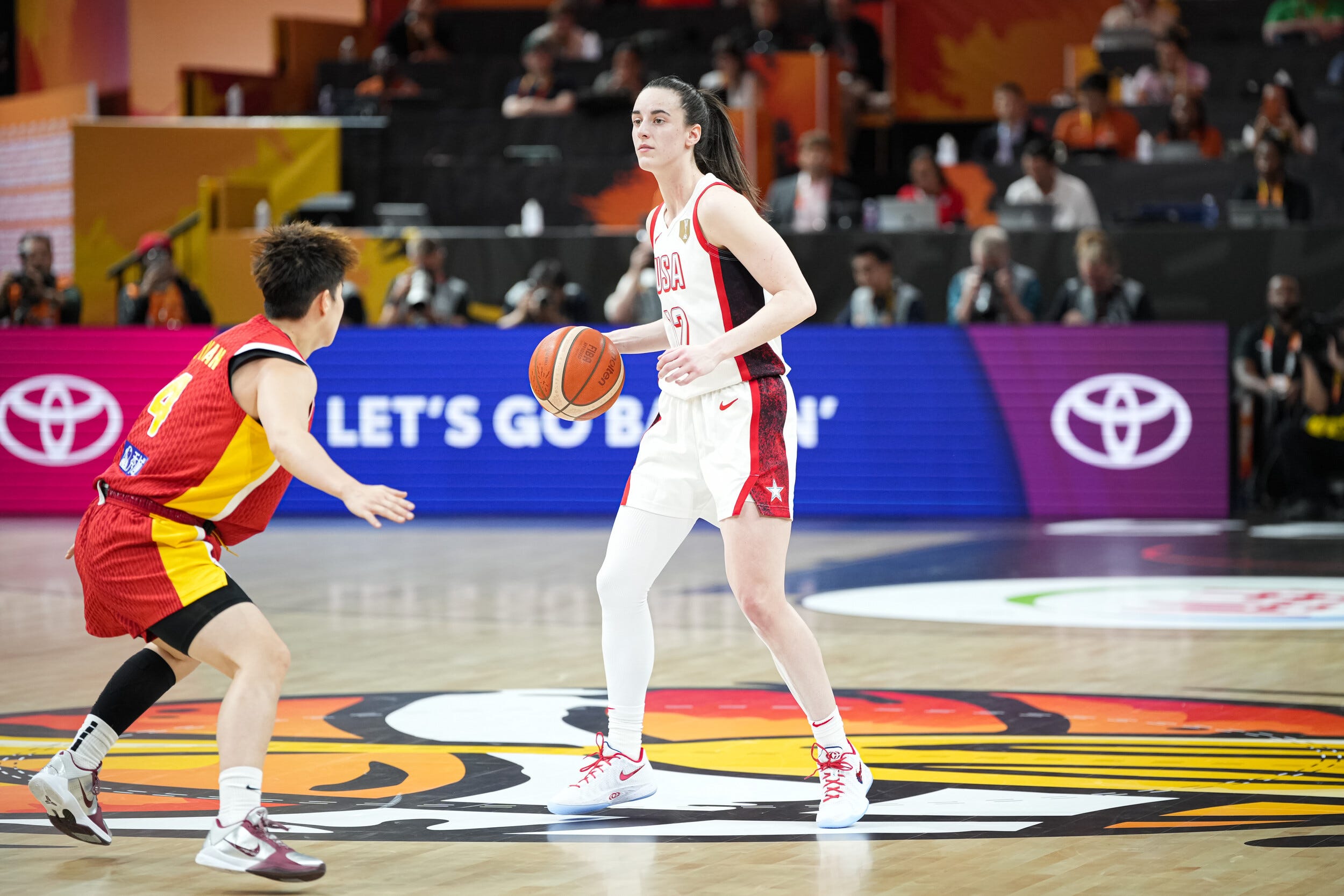
Well before Labor Day Weekend officially gets underway, basketball fans were treated to competitive basketball with their morning coffee.
Caitlin Clark, Aliyah Boston and the other 10 members of the U.S. Women’s Senior National Team opened up FIBA World Cup play exactly how you would expect: with depth, balance, and a large margin of victory.
Team USA jumped ahead by 13 points after one and grew its lead to 20 by halftime en route to a comfortable 94-61 victory over China Friday, taking control early and steadily pulling away.
With the tournament being played in Berlin, the game tipped off shortly after 8 a.m. ET so it’s understandable if you were unable to watch. But given Clark’s participation and the interest in the most dominant team in women’s basketball history, all of its games air live on TNT and are being streamed outside a paywall.
Clark, one of nine players making their World Cup debut, made an immediate impact.
First-year head coach Kara Lawson started the five veterans, but the needed jolt was provided about four minutes into the game when Clark and Boston were the first two Americans subbed in.
Clark played a game-high 25 minutes and finished with 14 points, 11 assists and zero turnovers, earning Player of the Game honors in her first appearances on this stage.
“I think being surrounded by five people that have won gold medals before at the highest level, you just kind of try to follow their lead and take every bit of wisdom that they can give you,” Clark said postgame. “Whatever role I have, I’m going to come in and do it to the best of my ability and play hard.”
It was an impressive introduction, but also a reminder of just how deep this U.S. roster is. She was left off the 2024 Olympic team and in her last two international competitions, she was named MVP of the World Cup qualifiers in San Juan, and then Player of the Game in Berlin on Day 1.
“I thought Caitlin was terrific coming off the bench, changing the tempo of the game, and her playmaking with 11 assists,” Lawson said.
All 12 players saw at least 12 minutes of action and every player scored. Sonia Citron, an injury replacement for Kelsey Plum, was the last to score — doing so on a cut to the basket and off an assist from Clark.
Entering the tournament, Clark arrived with her usual competitive spirit and in a giving mood. With all this talent, she knows the best thing she can do is push the pace and get others involved. So her focus is on facilitating, letting others eat and knowing her shots will come within the great ball movement that she initiates.
“Anybody I pass the ball to, it feels like they’re never going to miss a shot,” she said.
Lawson and the coaching staff know they have the talent; therefore, these three Group-Play games are about this team getting in rhythm and finding the right combinations.
Boston finished with seven points and two rebounds, and had the tall task — literally — of defending 7-foot-3 center Ziyu Zhang. Fever head coach Stephanie White, one of three assistants for Lawson, had the scout for the game and had to be pleased with the overall result.
China is a unique matchup due to its size. They present a lot of problems and Team USA did a good job of figuring it out.
The opening game is a chance to shake any nerves and establish an identity. There’s a new managing director (Sue Bird), a new head coach (Lawson), and 75% of the roster is new to the World Cup stage.
The USA roster is filled with talent, allowing them to lean on productive rotations and the hot hand. In this case, four players scored 12 points or more: Clark, Paige Bueckers, Rhyne Howard, and Jackie Young. The team shot 45%, made 14 of 18 free throws, and held China to 32% shooting despite their obvious height advantage.
When Clark entered, she changed the game with the standard she set with pace and ball movement. It was the second unit that broke things wide open.
There will be bigger games ahead, tougher opponents, and higher-pressure moments. But being named Player of the Game in her World Cup debut is an impressive way to open up competition in Berlin.
Clark had fun doing it, pausing for a moment to take it all in. No stage is too big for her, but this one was different.
“It’s so fun to see all the fans and their excitement and how much the women’s game is growing globally,” Clark said. “Even after the game, there was just so much excitement, and not only for myself, but for so many players on this team. That’s a really cool thing, and I think that will only continue to grow as we progress through the tournament.”
Team USA returns to action on Sunday at 2:45 p.m. ET against Italy.
Watch my postgame recap below:
And if you prefer audio form, make sure you are subscribed to the Fever Files Podcast.
Apple
Spotify
Engelbert To Retire At Year’s End
One hour after Team USA’s victory, the WNBA announced that commissioner Cathy Engelbert is choosing to retire at the end of the year.
She became the league’s first commissioner in 2019 and will leave her post after assisting with the transition to her successor.
“After more than seven years at the WNBA and more than 40 total years in business, I have made the decision to retire as WNBA Commissioner,” Engelbert said in a statement.
“I retire knowing we have built something bigger, stronger and more enduring than we could have imagined. I am grateful to the WNBA and NBA team owners and staff, players, investors, fans and the powerhouse league office staff, who believed in what this league could become. I retire with immense gratitude and tremendous optimism for the future of the WNBA, with the best yet to come.”
The league has experienced significant growth during her time leading the league, supercharged by the arrival of Clark in 2024. Since then, it has taken off.
The WNBA expanded from 12 to 15 teams and has plans to add three more by 2030: Cleveland, Detroit, and Philadelphia
“Cathy has presided over the WNBA through the most significant period of growth in the league’s 30-year history,” said NBA Commissioner Adam Silver. “We are grateful for Cathy’s leadership and unwavering commitment to the advancement of women’s basketball.”
The next commissioner first needs to be able to connect with stakeholders, especially the players. There needs to be a relationship, open dialogue and a mutual respect.
From there, the league needs someone who can lead, has a vision and takes action. The moment is now for the WNBA, and it needs someone with a passion for the game — someone who commands a room and leads with authority.
It’s not an easy job, but the possibilities are intriguing.


